The readings assigned for today’s meeting provided a more detailed history of the founding of the German State. For many years, the Holy Roman Empire was the ultimate ruling force for the Germanic peoples. However, things began to look bleak for the Empire starting in the 18th century. One of the main driving forces behind the demise of the Holy Roman Empire was the strength of the Prussian military force. In order to prevent the possibility of an invasion, the Prussian government armed itself and bolstered its military capabilities. As a result of growing hostilities between Prussia and Austria, a war broke out called the Silesian War. Prussian ended up winning this conflict and as a result, Austria ceded the greater part of Silesia in return Prussia would recognize Maria Theresa as the Hapsburg heiress to Austria. The other one of the main factors behind the fall of the Holy Roman Empire, and the eventual cause for unity among Germans, was the civil unrest in France in 1792 in between revolutions within and outside the country (93). Eventually, in 1797, the Emperor signed away the legitimacy of the Empire in the Peace of Campo Formio in 1797 (96). The result of the treaty narrowed down the number of German territories from 317 to 30, thus creating a more organized collective. Later on, on July 12, 1806, representatives of 16 states in the south and southwestern regions of Germany signed an act cutting connection with the Empire and went under a protection pact under Napoleon titled the Rheinbund (99). This spelled the end for the Holy Roman Empire and on August 6, 1806, Francis the II laid down the crown of the Holy Roman Empire (99).
While the Holy Roman Empire may have been something of the relative past, the German nation was still only something of a suggestion. The Germans of that time still identified with the ruling houses of their particular territories. The following historical events were the most compelling for me. Beginning in March 17, 1813, King Frederick William III of Prussia issued a call to arms against the French and Napoleon’s army (106). Over the next year, the allies of Prussia worked with the King and defeated Napoleon and his armies in the year 1814. At this point Central Europe was being held together by the Deutscher Bund.
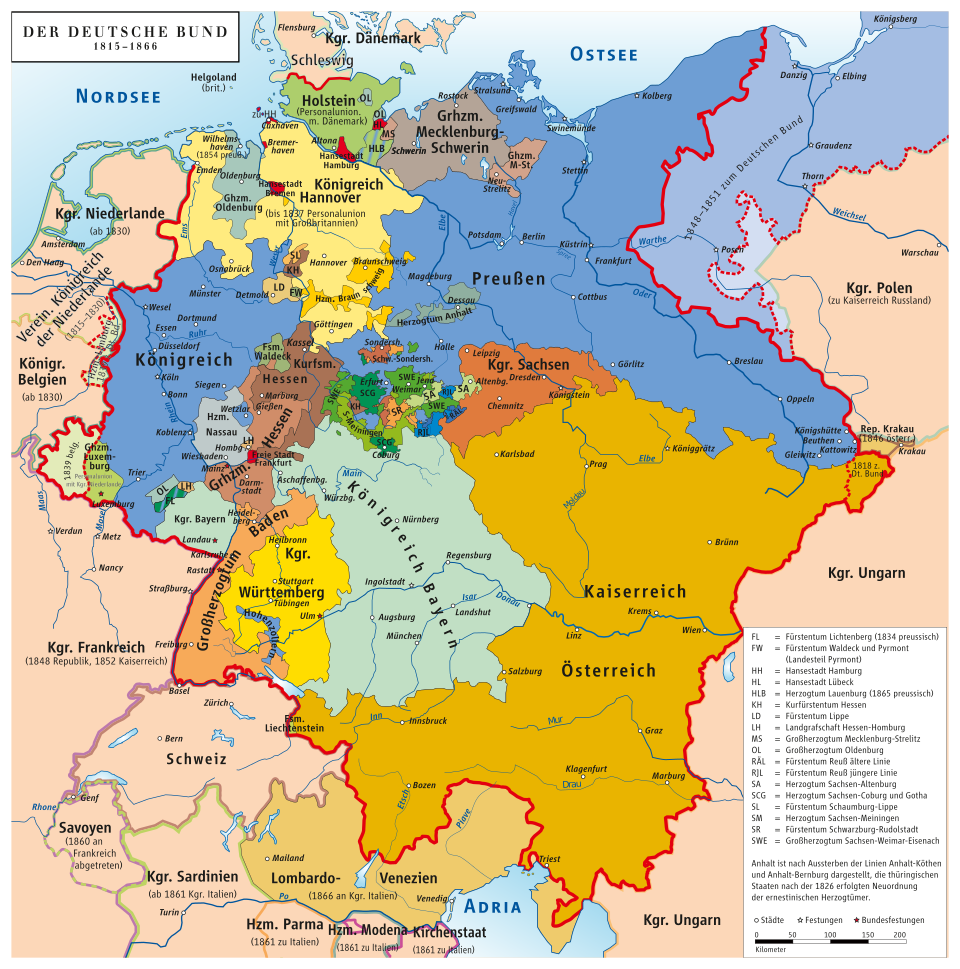 |
| Deutscher Bund |
This alliance was held together until news of a new overthrow of a French King sparked civil undrest over Europe. In response to such civil unrest, the German National Assembly convened in St. Paul’s Church on May 18, 1848 (124). The Assembly’s main objective was to draft and adopt a constitution to guarantee basic freedoms and to elect a national government. In the end, the constitution that was made became sort of a joke and was rejected by a majority of the German people. In 1870, the Franco-Prussian war broke out. This would eventually be called the Franco-German war and would last until the winter of 1871. An official peace accord was signed on February 26, 1871 and the Peace Treaty of Frankfurt was signed on May 10, 1871 (144). Following the end of the Franco-German War, King William I of Prussia was made German Emperor on January 18, 1871 (145).
 |
| Foundation of the German Empire 1871 |
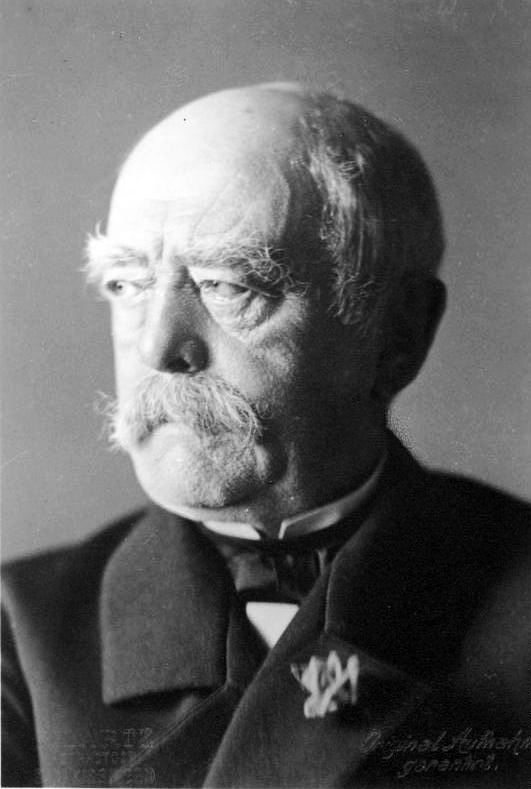 |
| Otto von Bismarck |
To end, the most compelling issue for me, as I showed in the above paragraph, was the fact that what seemed to really propel Germans to united and create a German state was many revolutions that started in France. This was compelling to me because I thought that the only time we could really see such a series of events was during the unrest that began in Egypt earlier in 2010. After the overthrow of the Egyptian government, other nations followed suit and revolutions are in action today.

No comments:
Post a Comment