Sunday, September 11, 2011

Third Posting

Before I watched this video, I only had a vague sense of what Martin Luther did.  From various history classes and church services I had known that Luther was a man who created the Protestant movement and Lutheranism, however I did not know he was such an influential character who caused as much of a social and religious revolution as he did a religious movement.  What really got my attention, and gave me a whole new amount of respect for Luther, was his stance against the Catholic church and how he expressed his dislike.  First off, not a lot of people these days would make a stance against an organization that would deliver swift violence in the form of burning at the stake or drowning as punishments for disobedience.
Luther Before the Diet of Worms

Luther, on the other hand, did and did it in a way that was both courageous and intelligent.  Secondly, Luther not only made arguments against the church and their ideals in a logical manner, but also threw in insults that were almost unheard of to be used against such a power.  That earned him a whole lot of respect in my mind.  His stance against the Catholic church and their practices caused a revolution for freedom of religion and a peaceful view of God.  To this day, I believe, the Catholic church is still feeling a lot of those affects.
Luther's Original 1534 Bible
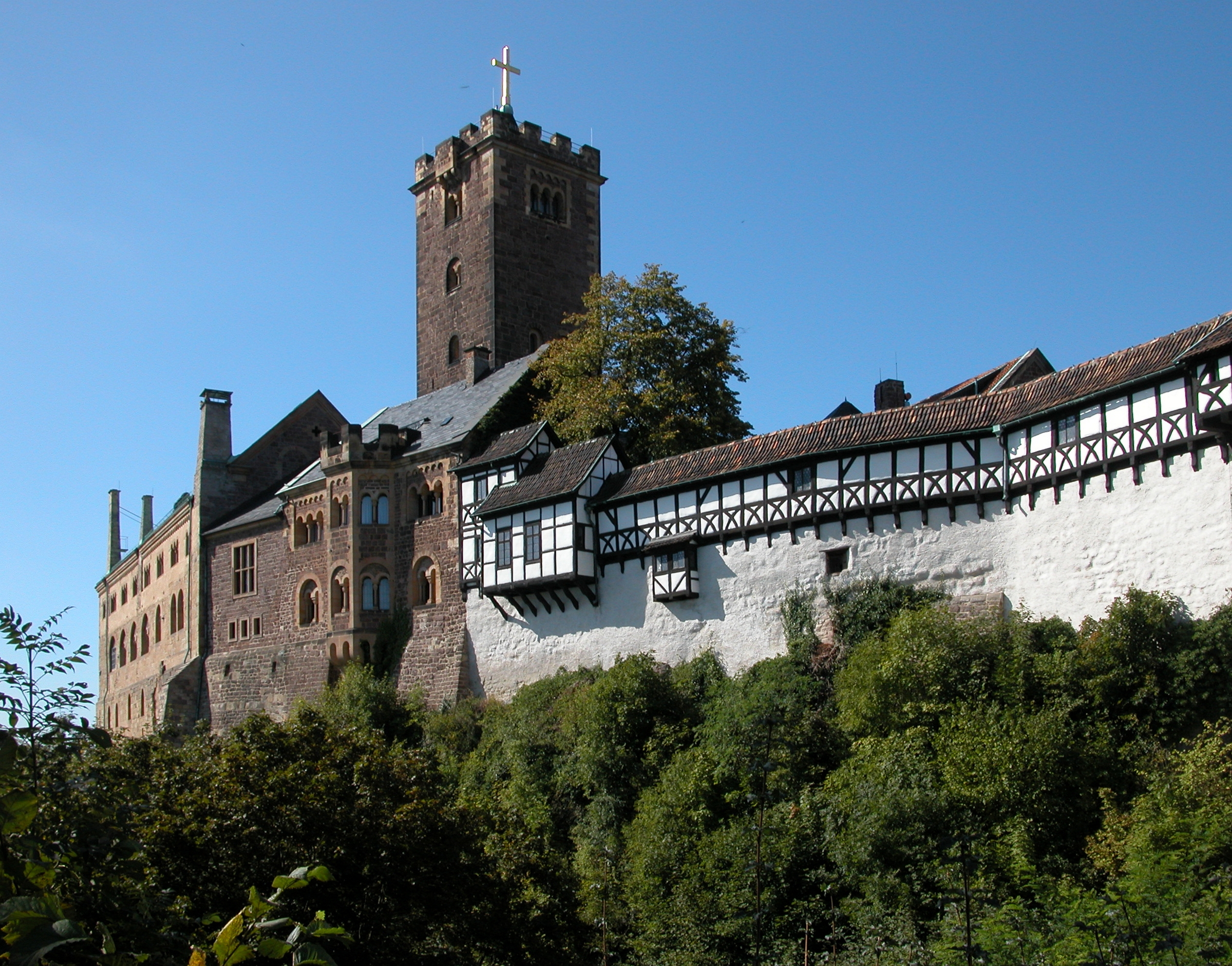
Wartburg Castle Location of Luther During his Translation of the Bible
Luther was of a high importance to the German-speaking lands.  During the later years of his life he translated the Bible into the German language.  This united all social classes of Germany and the German society.  Luther was also an important figure in the founding of the Americas because his ideals were used to set up the system of a free religious society.

Second Posting

The reading of the first and second chapters was an entertaining and enlightening one.  Personally though, the second chapter provided me with a more fruitful read.  If one looked at Germany today and it's governmental structure, they would have no idea of how disorganized the leadership used to be in the 15th-17th centuries.  This is what I found the most compelling, the hierarchical structuring and laws that Germania was composed of throughout these times.  While Germania was still considered part of the Holy Roman Empire, there were kings which ruled separately from the region in their own territories and principalities.  

Holy Roman Empire 1600
Detailed View of the Territories 1512
What really astounded me was the fact that  each king only had power in their own territory and every person in that territory had to follow the chosen religion of that particular ruler.  This fact seemed important because the government that is in charge of Germany now could look to the past to see how to better govern the country today.  Something else that intrigued me was that many people in Germania at this time did not consider themselves to be German in any sense.  However, they related more to the fact that they were descendants of the Trojans and still considered themselves Roman citizens.  It is amazing to me that Germany finally came out of that era with a huge sense of national pride.  Perhaps without the involvement of the Holy Roman Empire, Germania would have been more organized than it was during the 15-17th centuries.  

Thursday, September 8, 2011

First Posting

Room where Martin Luther translated the New Testament into German
There were a few places I could have gone to over D-term, but I chose to go to Germany.  The decision to go to Germany was easy, my parents have been there, my Aunt and Uncle speak German and go there every year, and I am very interested in the German culture and the history of the country.  I expect to learn and experience a wide variety of things.  One of the most important things I expect to learn from this trip is the history of Germany throughout the formation of the country to its present day standing as one of the most economically prosperous countries in the world.  Something that I would like to mention is that I have a huge interest in history.  I think the fact that we will be traveling around learning about multiple points in German history is a thrill because most of the historical settings have been preserved in the way they looked during that particular point in time.  Another important thing I would like to learn about is how a religious idea was spread through one man and transformed a country and many areas of the world.  To me, this is a fascinating part of history.  While I am not a Lutheran, I do appreciate the efforts that Martin Luther must have gone through in order to make a new branch of Christianity accessible to many people in Germany.  Something that I would like to experience while in Germany is to get a visit the Berlin wall, a concentration camp, and the memorial to the 20 July 1944 plotters at the Bendlerblock.

Bendlerblock with memorial in the background
 The one place I would like most to visit is the court at the Bendlerblock.  I believe, very strongly, that if the world got a chance to learn about Operation Valkyrie and the plotters, the world would understand that not all of Germany, especially the Officers in the Wehrmacht, were Nazis and supported Hitler.  The trip to Germany is a very important part of my academic career, not because I'm majoring or minoring in the language or the history, but because it is a chance to experience the history of the country first hand and to walk in the footsteps of those who became part of the German history.