Tuesday, November 1, 2011

The Road to Hitler's Germany


An issue that was particularly compelling for me was the road that was taken that lead from the Weimar Republic’s founding to the appointment of Hitler as Chancellor of Germany. Throughout my high school and middle school history classes, we would go over World War Two in great depth and study how Hitler was the leader of the Nazis and how Hitler’s power eventually was destroyed.  We would also go over World War One and occasionally hear about the details of the Treaty of Versailles.  However, both were covered in very brief detail, in fact, I had never heard of the Weimar Republic until my sophomore year of college.  What we failed to cover in classes were the economic woes, political tensions, and the German’s worldviews following a devastating loss in World War One which led to the eventual support of Hitler’s National Socialist German Workers Party and his inevitable appointment as Chancellor. 

After the German’s loss to the Allied Powers on November 11, 1918, there was a feeling of shame and defeat like no other.  Unfortunately these feelings would turn into embarrassment and anger as the Allied Powers forced the German government to sign the Treaty of Versailles, on June 28, 1919, which required the Germans to repay the countries involved in the war effort, demilitarize their entire armed forces, and to give the Allied Powers land that was previously considered to be part of Germany. (203). Only two months after the Treaty of Versailles was signed, the Weimar constitution was written on August 14, 1919, effectively bringing in democracy to Germany. (205). For the next couple of years, Germany was in a state of economic hardship unlike any other.  Inflation was one of the biggest problems plaguing the country, and unemployment was at an all-time high.  The Republic wasn’t gaining many supporters in the fact that the solution to the money woes was to print more money which, in turn, caused a higher inflation rate.  One of the first steps on the way to a more prosperous Germany was the Dawes Plan.  The Dawes Plan was signed and enacted on April 9, 1923 and required the Allied Powers to leave German lands and offered an opportunity to explore possible revisions of the reparations policy.  This plan was a step forward to giving Germany back the dignity that was stolen at the conclusion of World War one.  Another big step was the admission of Germany into the League of Nations in September 1926 and the Young Plan of 1930 which granted further reduction in German reparation payments.  Between the years of 1924 and 1930, Germany increased production rates and made headway in exportation.  However, the Weimar Republic was unable to stave off the huge wage costs which reduced the companies’ willingness to invest in the economy and kept unemployment rates at a high level. (218-219). An issue which plagued the Weimar Republic was their apparent lack of attention being paid to the middle class and the rich.  While the Republic was helping to redistribute the wealth among the poor and lower class, the middle class and the upper class began to have a feeling of distrust for the government and as a result, the Republic lost a lot of public support.  In the middle of the growing distrust towards the Republic, Paul von Hindenburg was elected to office.  While Hindenburg had potential, he lost control of the Republic through lack of political knowledge from Hindenburg and Chancellor Hermann Mueller.  On March 27, 1930, the Republic was no more. 
Signing of Treaty of Versailles

The ramifications of Germany’s economic and political woes came to a head soon after the Republic was disbanded as the German Communist Party and Hitler’s National Socialist German Workers Party (NSDAP) gained large numbers of members and supporters in a struggle for power. (230). The NSDAP was growing fast and gaining more support for a couple of reasons:  Hitler was an exceptional public speaker and would play on people’s emotions and lay out a plan of action rather than just state the party’s agenda and Hitler’s party was a huge influence on the younger generations. During the struggle for power, in 1932, the world allowed Germany to rearm itself.  On June 30th, 1933, after being convinced of a conspiracy against him, Hindenburg appointed Hitler as Chancellor as Germany.  From this point on, the clouds of war would silently cover the entirety of Europe and dash Germany’s hopes of peace for a long time to come. 

Hitler on night of his appointment as Chancellor

Wednesday, October 5, 2011

Founding of a German State

The readings assigned for today’s meeting provided a more detailed history of the founding of the German State.  For many years, the Holy Roman Empire was the ultimate ruling force for the Germanic peoples.  However, things began to look bleak for the Empire starting in the 18th century.  One of the main driving forces behind the demise of the Holy Roman Empire was the strength of the Prussian military force.  In order to prevent the possibility of an invasion, the Prussian government armed itself and bolstered its military capabilities. As a result of growing hostilities between Prussia and Austria, a war broke out called the Silesian War.  Prussian ended up winning this conflict and as a result, Austria ceded the greater part of Silesia in return Prussia would recognize Maria Theresa as the Hapsburg heiress to Austria.  The other one of the main factors behind the fall of the Holy Roman Empire, and the eventual cause for unity among Germans, was the civil unrest in France in 1792 in between revolutions within and outside the country (93).  Eventually, in 1797, the Emperor signed away the legitimacy of the Empire in the Peace of Campo Formio in 1797 (96).  The result of the treaty narrowed down the number of German territories from 317 to 30, thus creating a more organized collective.  Later on, on July 12, 1806, representatives of 16 states in the south and southwestern regions of Germany signed an act cutting connection with the Empire and went under a protection pact under Napoleon titled  the Rheinbund (99).  This spelled the end for the Holy Roman Empire and on August 6, 1806, Francis the II laid down the crown of the Holy Roman Empire (99). 
            While the Holy Roman Empire may have been something of the relative past, the German nation was still only something of a suggestion.  The Germans of that time still identified with the ruling houses of their particular territories.  The following historical events were the most compelling for me.  Beginning in March 17, 1813, King Frederick William III of Prussia issued a call to arms against the French and Napoleon’s army (106).  Over the next year, the allies of Prussia worked with the King and defeated Napoleon and his armies in the year 1814.  At this point Central Europe was being held together by the Deutscher Bund.
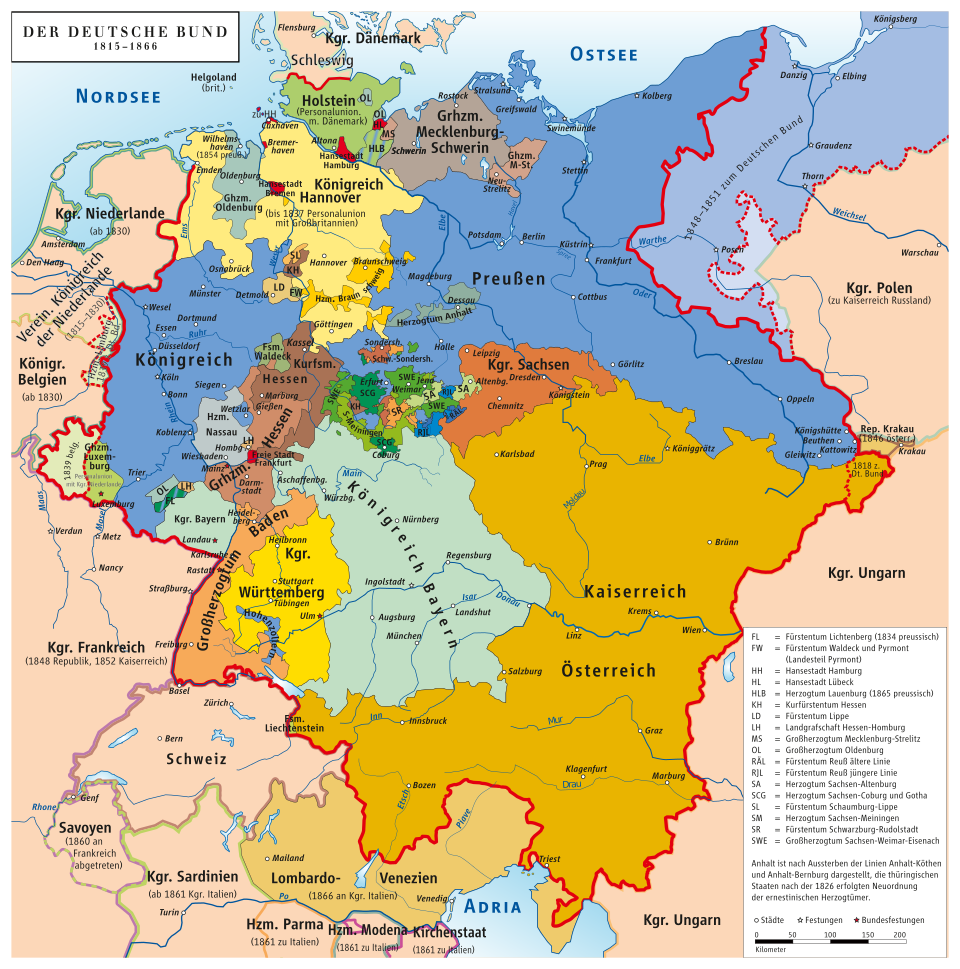
Deutscher Bund
 
This alliance was held together until news of a new overthrow of a French King sparked civil undrest over Europe.  In response to such civil unrest, the German National Assembly convened in St. Paul’s Church on May 18, 1848 (124).  The Assembly’s main objective was to draft and adopt a constitution to guarantee basic freedoms and to elect a national government.  In the end, the constitution that was made became sort of a joke and was rejected by a majority of the German people.  In 1870, the Franco-Prussian war broke out.  This would eventually be called the Franco-German war and would last until the winter of 1871.  An official peace accord was signed on February 26, 1871 and the Peace Treaty of Frankfurt was signed on May 10, 1871 (144).  Following the end of the Franco-German War, King William I of Prussia was made German Emperor on January 18, 1871 (145). 
Foundation of the German Empire 1871
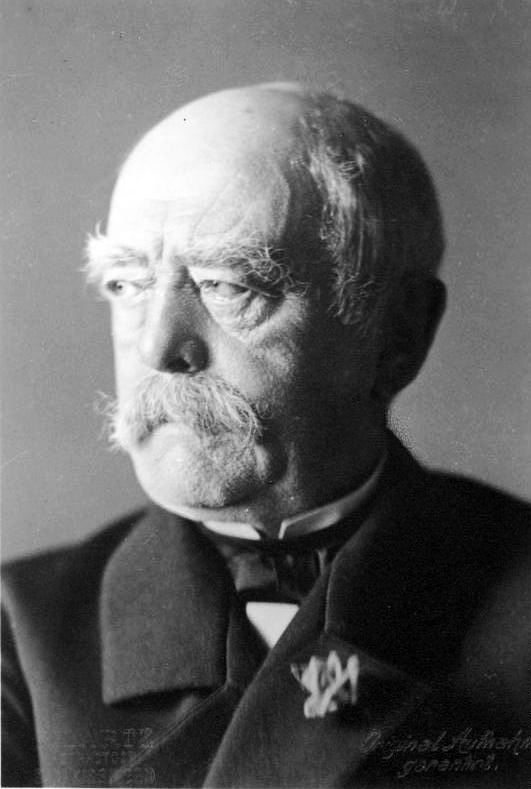
Otto von Bismarck

            To end, the most compelling issue for me, as I showed in the above paragraph, was the fact that what seemed to really propel Germans to united and create a German state was many revolutions that started in France.  This was compelling to me because I thought that the only time we could really see such a series of events was during the unrest that began in Egypt earlier in 2010.  After the overthrow of the Egyptian government, other nations followed suit and revolutions are in action today.  

Sunday, September 11, 2011

Third Posting

Before I watched this video, I only had a vague sense of what Martin Luther did.  From various history classes and church services I had known that Luther was a man who created the Protestant movement and Lutheranism, however I did not know he was such an influential character who caused as much of a social and religious revolution as he did a religious movement.  What really got my attention, and gave me a whole new amount of respect for Luther, was his stance against the Catholic church and how he expressed his dislike.  First off, not a lot of people these days would make a stance against an organization that would deliver swift violence in the form of burning at the stake or drowning as punishments for disobedience.
Luther Before the Diet of Worms

Luther, on the other hand, did and did it in a way that was both courageous and intelligent.  Secondly, Luther not only made arguments against the church and their ideals in a logical manner, but also threw in insults that were almost unheard of to be used against such a power.  That earned him a whole lot of respect in my mind.  His stance against the Catholic church and their practices caused a revolution for freedom of religion and a peaceful view of God.  To this day, I believe, the Catholic church is still feeling a lot of those affects.
Luther's Original 1534 Bible
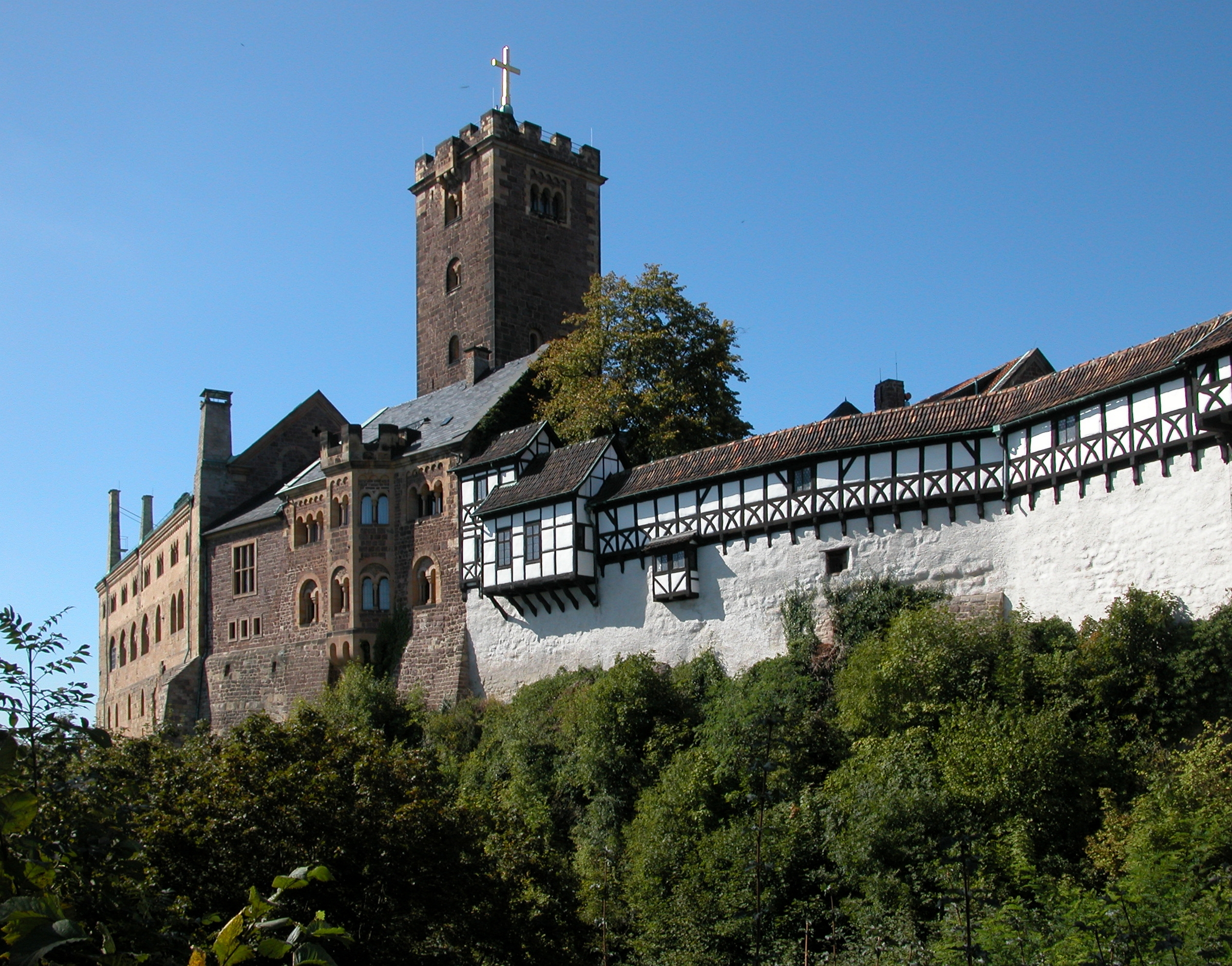
Wartburg Castle Location of Luther During his Translation of the Bible
Luther was of a high importance to the German-speaking lands.  During the later years of his life he translated the Bible into the German language.  This united all social classes of Germany and the German society.  Luther was also an important figure in the founding of the Americas because his ideals were used to set up the system of a free religious society.

Second Posting

The reading of the first and second chapters was an entertaining and enlightening one.  Personally though, the second chapter provided me with a more fruitful read.  If one looked at Germany today and it's governmental structure, they would have no idea of how disorganized the leadership used to be in the 15th-17th centuries.  This is what I found the most compelling, the hierarchical structuring and laws that Germania was composed of throughout these times.  While Germania was still considered part of the Holy Roman Empire, there were kings which ruled separately from the region in their own territories and principalities.  

Holy Roman Empire 1600
Detailed View of the Territories 1512
What really astounded me was the fact that  each king only had power in their own territory and every person in that territory had to follow the chosen religion of that particular ruler.  This fact seemed important because the government that is in charge of Germany now could look to the past to see how to better govern the country today.  Something else that intrigued me was that many people in Germania at this time did not consider themselves to be German in any sense.  However, they related more to the fact that they were descendants of the Trojans and still considered themselves Roman citizens.  It is amazing to me that Germany finally came out of that era with a huge sense of national pride.  Perhaps without the involvement of the Holy Roman Empire, Germania would have been more organized than it was during the 15-17th centuries.  

Thursday, September 8, 2011

First Posting

Room where Martin Luther translated the New Testament into German
There were a few places I could have gone to over D-term, but I chose to go to Germany.  The decision to go to Germany was easy, my parents have been there, my Aunt and Uncle speak German and go there every year, and I am very interested in the German culture and the history of the country.  I expect to learn and experience a wide variety of things.  One of the most important things I expect to learn from this trip is the history of Germany throughout the formation of the country to its present day standing as one of the most economically prosperous countries in the world.  Something that I would like to mention is that I have a huge interest in history.  I think the fact that we will be traveling around learning about multiple points in German history is a thrill because most of the historical settings have been preserved in the way they looked during that particular point in time.  Another important thing I would like to learn about is how a religious idea was spread through one man and transformed a country and many areas of the world.  To me, this is a fascinating part of history.  While I am not a Lutheran, I do appreciate the efforts that Martin Luther must have gone through in order to make a new branch of Christianity accessible to many people in Germany.  Something that I would like to experience while in Germany is to get a visit the Berlin wall, a concentration camp, and the memorial to the 20 July 1944 plotters at the Bendlerblock.

Bendlerblock with memorial in the background
 The one place I would like most to visit is the court at the Bendlerblock.  I believe, very strongly, that if the world got a chance to learn about Operation Valkyrie and the plotters, the world would understand that not all of Germany, especially the Officers in the Wehrmacht, were Nazis and supported Hitler.  The trip to Germany is a very important part of my academic career, not because I'm majoring or minoring in the language or the history, but because it is a chance to experience the history of the country first hand and to walk in the footsteps of those who became part of the German history.